Keynote speaking
A keynote on being human.
Thirty-five years in front of rooms, and one subject: the ego that runs a life, and what becomes possible once it is seen.
I am a philosopher by training. I wrote my memoir on Homer's Iliad and Odyssey, and I have never forgotten what he said, eight centuries before the birth of Christ.
Of all that on earth has force and movement, no being is more miserable than Man.
It seems indeed that nothing has altered since the beginning of time. Man has changed his clothes. He has progressed on every front: medicine, science, technology, sociology, physics, mathematics. Except in one area. He has stayed exactly the same miserable and grandiose character, whether he is fighting on the plain of Troy or waiting for his train today.
My point is that a transformation has become a must, if we are to succeed at managing the unbelievable advances of our time.
We need responsibility, integrity and care to become as automatic as force, manipulation and unconsciousness have been.
One point about quantum physics
Quantum physics is revolutionising our view of the universe. It moves us from a traditional physics, built on the assumption that all things are made of atoms, to a quantum view proposing that all things, including atoms, are made of consciousness. Which is good news for me, since consciousness is what my life is about.
If we adopt that view, the question becomes this.
Could the source of human despair simply be a persistent confusion as to the nature of being?
Four questions I am asked everywhere.
The mechanismWhat is the ego?
Psychoanalysis, psychology, and psychiatry have extensively studied the formation of the human personality. They identify stages in a child’s development, document how defences, beliefs, and attachments form, and show that each age brings its own gains and wounds. Despite their different approaches, these disciplines converge on the idea that a large part of what we call the “self” is the result of early conditioning.
The ontological approach I propose builds on this tradition, but puts it at the service of awakening rather than merely understanding. Before the age of about twenty, most fundamental decisions about “who I am”, “what life is worth”, and “what I must do to be loved or feel safe” have already been made, internalised, and stored in the system; they become what Hawkins would call “energetic attractors”.
From that point on, barring a major shock or a radical awakening, the rest of one’s life is often nothing more than a repetition of these old choices. We replay the same scenarios, reactivate the same fears, and pursue the same compensations — exactly what Zukav describes as the personality that repeats, over and over again, reactions born of fear instead of allowing the authentic power of the soul to express itself.
The paradoxWhy can a good life still feel empty?
Survival describes the backdrop against which the sleepwalker operates: an inner world made up of fear, defence, and mistrust. It is a paradigm, a way of viewing reality in which every situation seems potentially threatening, keeping the automatic ego in a constant state of alert.
In other words, survival is the reflexive response to the illusion of an ontological danger, as if the person’s very existence were constantly at stake. As long as this illusion prevails, consciousness remains trapped in protective reactions rather than in a trusting openness to life.
The consequence of this is suffering, and a lack of fulfilment.
The shiftWhat changes when we stop just surviving?
Being alive
Being alive, in this context, is not limited to the fact that your heart beats and your body breathes. Being alive means that your soul is the source of your thoughts, your actions, and the results you create. Your choices then arise from alignment with your essence rather than from your conditioning.
Being in survival mode: the sleepwalker
What I call a “sleepwalker” is the self that is identified with the mind and with fear.
A sleepwalker lives in a state of survival. In this state, it is the automatic and unconscious ego that fuels your thoughts, your actions, and the outcomes of your life. You then act as if you were constantly teetering between life and death, in an in-between state comparable to that of a sleepwalker, neither truly awake nor completely asleep. The sleepwalker walks, speaks, and makes decisions, but without truly knowing what they are doing. They do not see their actions or their underlying causes; this is what we might call the sleep of unconsciousness. In this state, we survive life more than we truly live it; we survive others more than we truly encounter them; and we perceive only illusions.
To survive is to have no true relationship with what is. The world is no longer seen as it is, but through the filter of fear, judgment, comparison, and mistrust.
The invitationHow can we be the best we can be?
All of this — detachment, loosening one’s beliefs, cultural deprogramming, the practice of self-love, and choice — has a single purpose: to make room for love to reveal itself.
Love is not blind; it sees everything. It embraces all the instruments in the symphony of existence, even those that are temporarily out of tune. It is ignorance that is blind: blind to the chains we impose on ourselves, blind to beauty, blind to the fact that, beneath all the stories, we are already made of the very substance we seek.
When the chains fall away and the stories subside, joy arises in the simplest things: a sunset, a child’s laughter, a brief exchange of glances with a stranger on the street.
The invitation is constant and radical: to choose reality, to choose oneself, to choose this moment, and in doing so, to allow the timeless space of love to emerge right where we are.
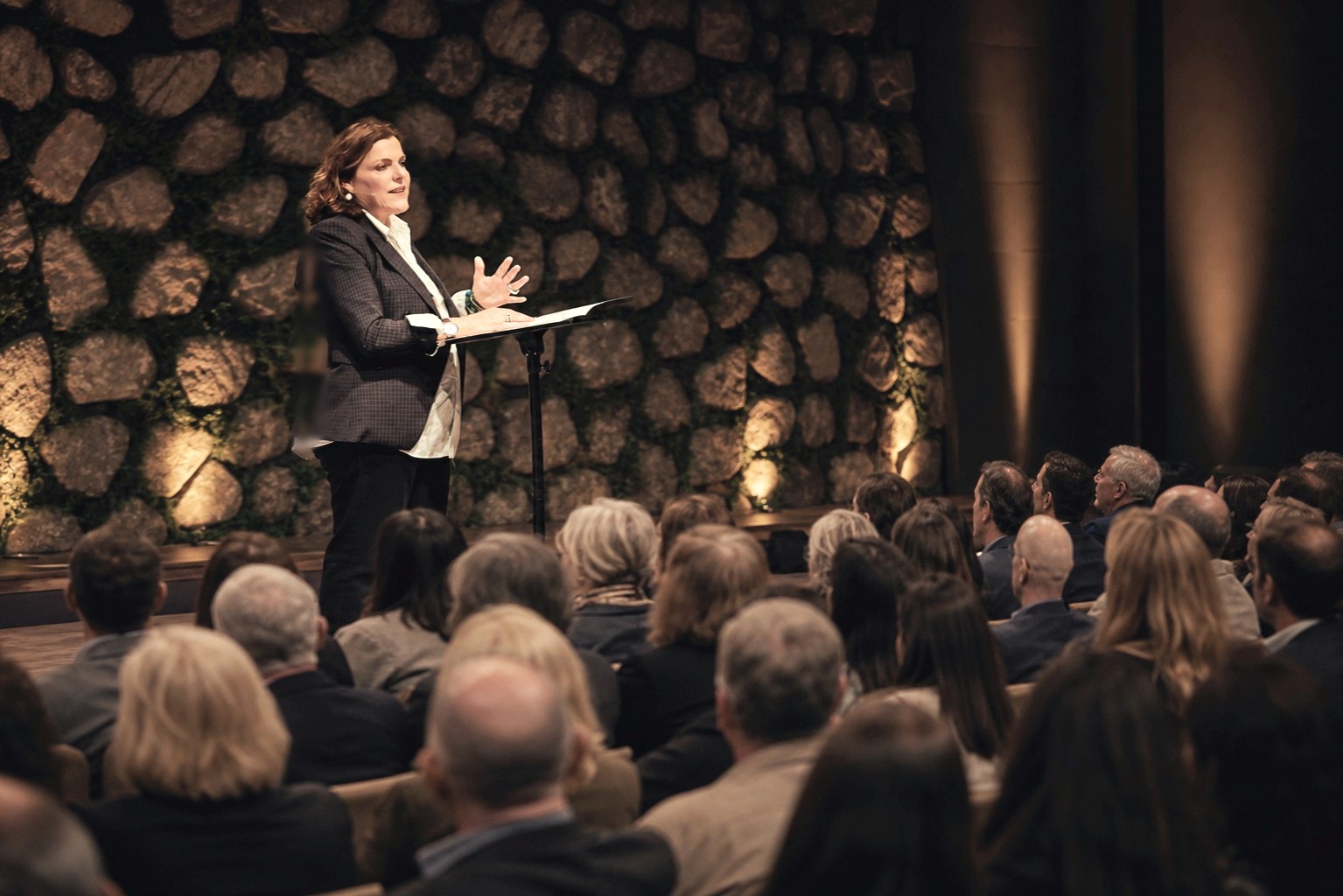
Thirty-five years in front of rooms.
I have led transformational seminars for more than eighty thousand people, across more than twenty countries. I was a top-performing forum leader at Landmark Worldwide, guiding thousands through rigorous programmes, before leaving to study with spiritual masters, train with shamans in the Amazon, and meditate with His Holiness the Dalai Lama in Ladakh.
I hold two master's degrees in philosophy, I have written three books, and I have worked for the United Nations. I have also been a helicopter pilot, a designer, a relief worker, a war refugee and a chief executive. I have been shot at, shipwrecked and widowed.
I say this only so you know what stands behind the talk. I am not a motivational speaker. I am an expert in ontology, the study of being, and I speak plainly about the one thing I know.
Sophie McLean is the most skilled and experienced mediator, facilitator, strategic planning expert, mentor and consultant that I have worked with. After more than twenty years with UNDP, I have worked with a great many experts in these areas.
Charles Ian McNeill, Ph.D · Senior Policy Advisor, Environment & Energy Group, United Nations Development Programme
Like most people, I grew up with a set of cultural filters that limited my view of the world, and which imposed a limit on the idea I had of my professional standing as a woman.
Once those filters were gone, I gained a new perspective on my relationship with the world, with the people around me, and even with myself, which allowed me to reach a new level of efficiency and performance.
That productivity was applied beyond my career, to my personal and family life. Obstacles I had not even seen have disappeared, allowing for a new depth of communication and intimacy.
Running a business is complex. This discipline has had a real impact on my ability to function as an entrepreneur.
Lamia Berrada · Présidente du Directoire, Bottu

Awareness is the ultimate power.
Booking
Tell me about your room.
Conferences, leadership programmes, universities, in-house gatherings. Tell me who will be in the room, how long you have, and what you are hoping they leave with. I will tell you honestly whether I am the right person for it.
I speak in English and in French.
I take my audiences seriously, not significantly.